
Why Audiobook Subscription Services Are Growing
🔊 Prefer listening? Hit play and enjoy the audio version 🔊
Subscription fatigue is one of the defining consumer stories of the past three years. According to Deloitte’s Digital Media Trends survey, 41% of streaming subscribers cancelled at least one service in the past six months, and roughly three-quarters say they’re frustrated by continual price increases across their entertainment subscriptions. Video streaming, in particular, has hit a wall: household spending on subscription video on demand has stayed roughly flat, and platforms are now leaning on ad-supported tiers rather than new sign-ups to keep growth alive.
Audiobooks are behaving differently. Sales revenue reached $2.43 billion in 2025, up 9% year over year, and the number of active titles in the market grew 43%. That is not the profile of a mature, fatigued category. It’s the profile of a format still expanding its catalog, its audience, and its addressable market simultaneously. For publishers, EdTech companies, and corporate content owners, understanding why audiobook subscriptions are the exception to broader subscription fatigue is more useful than simply noting that they’re growing.
Why Subscription Models Continue to Grow
The common explanation for subscription growth is that consumers prefer predictable monthly costs over one-off purchases. While this is true, it does not fully explain why some subscription categories continue to expand while others face increasing competition and customer fatigue.
One important difference lies in the type of value each subscription provides. Some subscription services rely heavily on a fixed catalog, where users may eventually feel they have consumed the content they were most interested in. Video streaming platforms, for example, often depend on a steady flow of new releases and popular titles to maintain engagement, as viewers can quickly move through their preferred shows and movies.
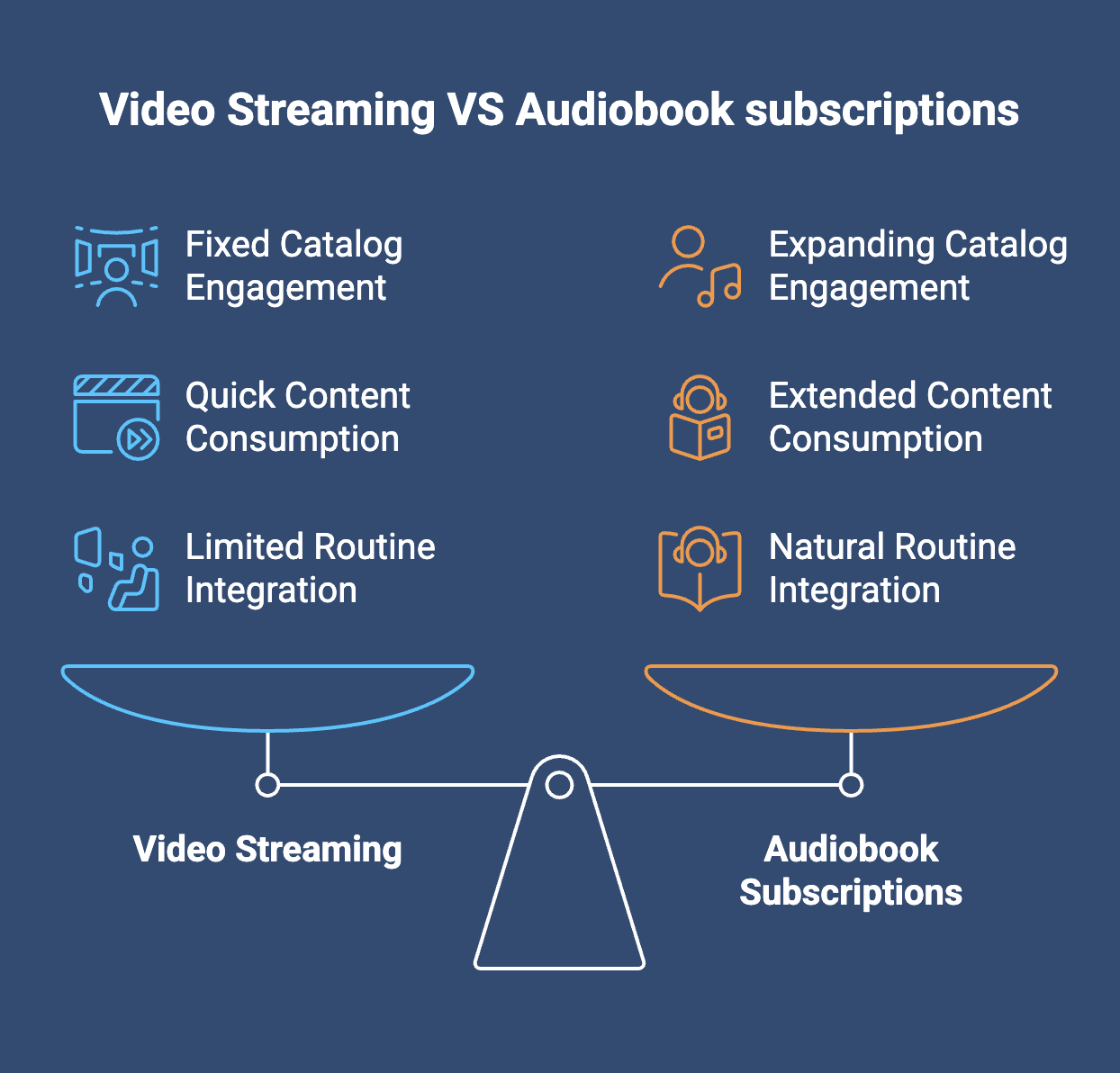
Audiobook subscriptions operate differently. A single title typically requires several hours of listening to complete, and publishing output continues to add new content across genres, languages, and audiences. With publishers reporting 750,000+ active audiobook titles available in 2025, subscribers have ongoing opportunities for discovery rather than simply exhausting an existing selection. However, long-term retention depends not only on catalog size but also on factors such as content discovery, personalization, pricing, and the overall listening experience.
The continued growth of audiobook subscriptions suggests that the format benefits from a combination of factors: expanding catalogs, growing consumer adoption, and the ability of audio content to fit naturally into daily routines such as commuting, exercising, and multitasking.
How Consumer Behavior Has Changed
Audiobook consumption habits reveal a second structural advantage: audiobook listeners rarely rely on a single access channel, which insulates the category from the price sensitivity that’s eroding other subscription businesses. Among listeners who consumed an audiobook in the past year, the Audio Publishers Association reports that 49% purchased directly from a website or app, 48% used a subscription service, 46% borrowed through a digital library app, and 42% used credits from a dedicated service, with meaningful overlap across all four.
That overlap matters strategically. A video streaming subscriber who cancels typically stops consuming that platform’s content entirely. An audiobook listener who cancels a subscription frequently migrates to library borrowing or direct purchase rather than abandoning the format. The audiobook subscriber base isn’t really “subscribers” in the video-streaming sense; it’s a population of habitual audio listeners who move fluidly between access methods, which makes total category revenue far more resilient to any single platform’s pricing decisions than a typical subscription business. Publishers who understand this should be building content strategy around the format’s durability across access channels, not around loyalty to one subscription platform.

The Economics Behind Subscription Businesses
Subscription businesses generally succeed or fail based on the relationship between customer acquisition cost, churn rate, and the marginal cost of serving an additional subscriber. Audiobook subscription economics are unusually favorable on the third variable in a way that’s specific to the format.
Once a title is professionally narrated, mastered, and distributed, the marginal cost of an additional listener streaming it is close to zero. This is not unique to audiobooks; it’s true of any digital content subscription. What is specific to audiobooks is that the fixed production cost per title, driven by professional narration and studio-grade post-production, is recovered over a genuinely long revenue tail, because listener demand for a well-produced audiobook doesn’t decay the way demand for a topical podcast episode or a seasonal streaming show does. A well-produced audiobook of an evergreen title can generate subscription-driven revenue for a decade with no further production investment, which is a materially better payback profile than most subscription content categories can offer.
This has a direct implication for how publishers should think about production budgets: underinvesting in narration quality to save costs on a title that will generate revenue for ten-plus years is a false economy in a way it isn’t for content with a six-month shelf life.
Why Publishers Are Investing More in Audio
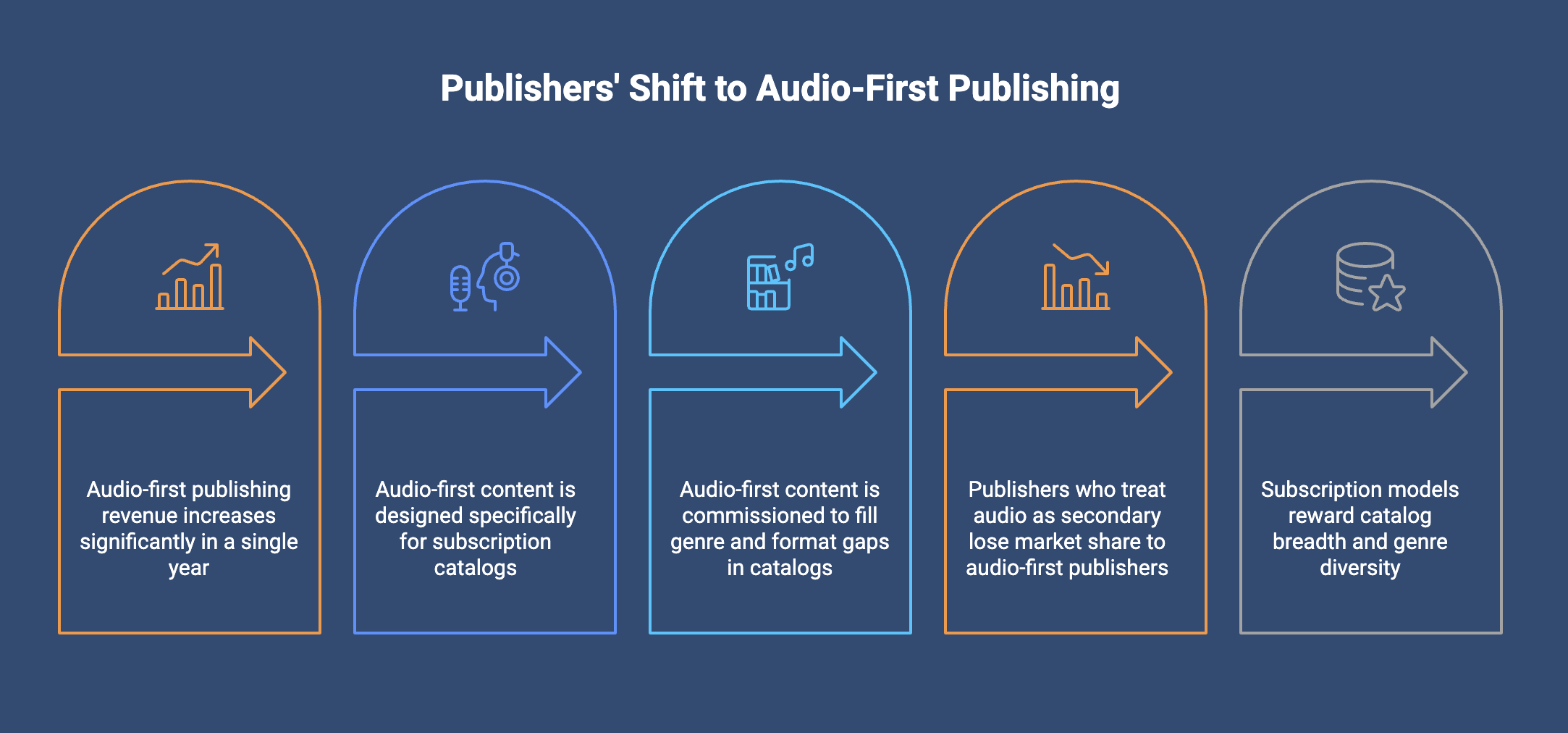
Publishers are responding to this economics rationally. Audio-first publishing, meaning titles conceived and produced as audio rather than adapted from print afterward, saw revenue jump from $91.1 million to $136 million in a single year, a 50% increase, now accounting for 6% of total net audiobook revenue.
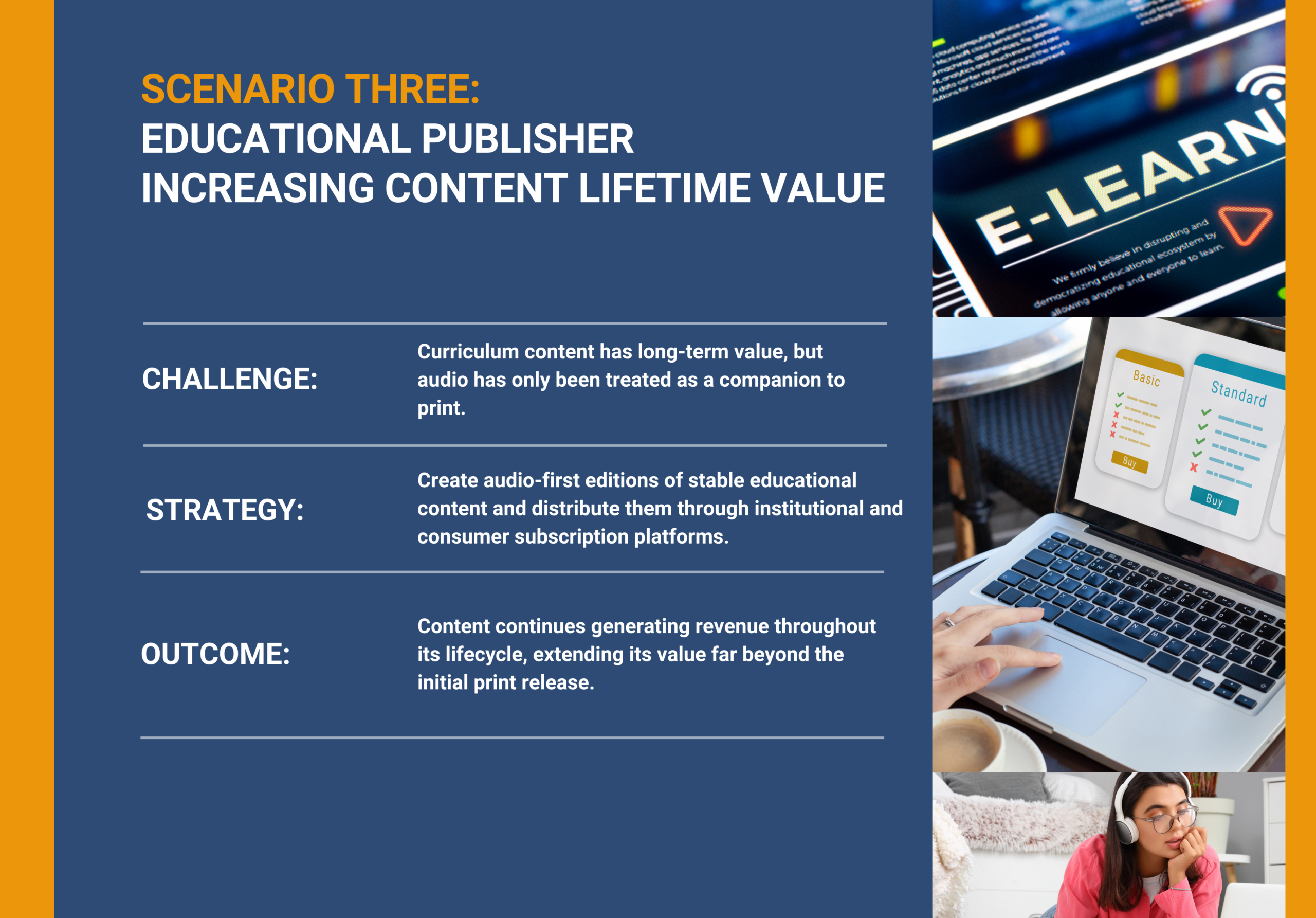
That shift is more significant than the percentage suggests. Audio-first content is designed from the outset for the subscription catalog model: it doesn’t need to compete with a print edition’s expectations, and it can be commissioned specifically to fill genre or format gaps that subscription platforms are actively seeking to diversify their catalogs. Publishers who treat audio as a secondary format, produced only after a print or ebook edition proves itself commercially, are ceding the fastest-growing segment of the category to publishers willing to commission audio-first. The subscription model rewards catalog breadth and genre diversity more than it rewards any single title’s blockbuster performance, which changes the calculus for what’s worth greenlighting as audio-original content.
How Subscription Platforms Influence Audiobook Production
Subscription and library-driven distribution models change production priorities in ways that a one-off retail sale doesn’t. When revenue depends on subscribers browsing a catalog and choosing what to sample, discoverability and consistency across a catalog matter more than they would for a single frontlist bestseller sold on its own marketing budget.
This shows up practically in a few ways. Series consistency, meaning matching narrator voice and production quality across sequential titles, becomes a retention driver rather than a nice-to-have, because subscription platforms surface “more like this” recommendations that depend on a listener’s prior experience with a narrator or series holding up. Backlist catalog depth becomes a genuine commercial asset rather than dead inventory, since subscription browsing behavior surfaces older titles that a retail-only sales model would never resurface. Publishers optimizing purely for frontlist launches are underexploiting the subscription model’s actual mechanics, which reward publishers with deep, well-produced, consistently narrated backlists over publishers chasing individual hits.
The Role of AI in Scaling Audiobook Catalogs
AI’s role in this shift is frequently overstated in one direction and understated in another. It is not primarily a tool for replacing narrators; the market data doesn’t support that framing. AI-narrated titles represented just 0.03% of audiobook sales revenue in 2025, and listener willingness to try an AI-narrated title actually declined year over year, from 70% to 61%. Subscription platforms competing on catalog trust and listener retention have little incentive to prioritize a production method that measurably reduces listener enthusiasm.
Where AI is genuinely changing catalogue economics is upstream of the finished product: accelerating pronunciation quality assurance across large multilingual batches, managing consistency checks across long series with multiple narrators, and speeding up the production pipeline for draft narration that a human narrator or director still reviews, corrects, and finalizes. This is the more interesting economic story: AI doesn’t eliminate the human narration cost that listeners are demonstrably still paying for, but it does reduce the fixed cost of getting a title from manuscript to publishable, quality-assured audio. As production becomes more efficient, publishers can bring a broader range of backlist and niche titles into audio, expanding catalog depth without compromising quality. Every additional title that clears the production threshold strengthens a publisher’s catalogue, giving listeners more choice and creating the depth that subscription platforms increasingly reward.
How Corporate Learning Is Adopting Subscription Thinking
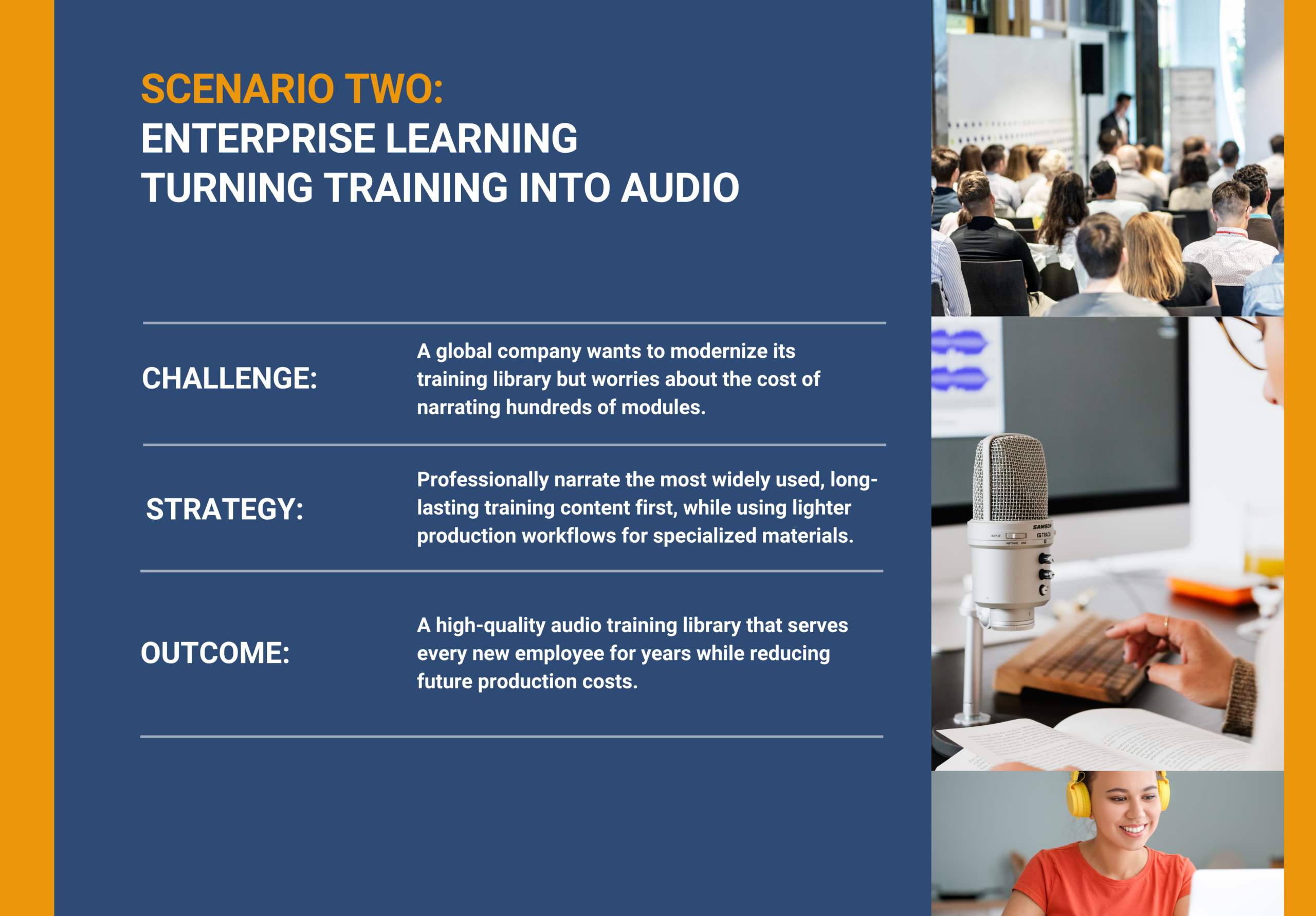
Corporate learning and development functions are independently arriving at a version of the same subscription logic, even where no consumer subscription product exists. Training departments increasingly manage internal audio content the way a subscription publisher manages a catalog: as a growing library that employees browse and revisit, rather than a series of one-time training events.
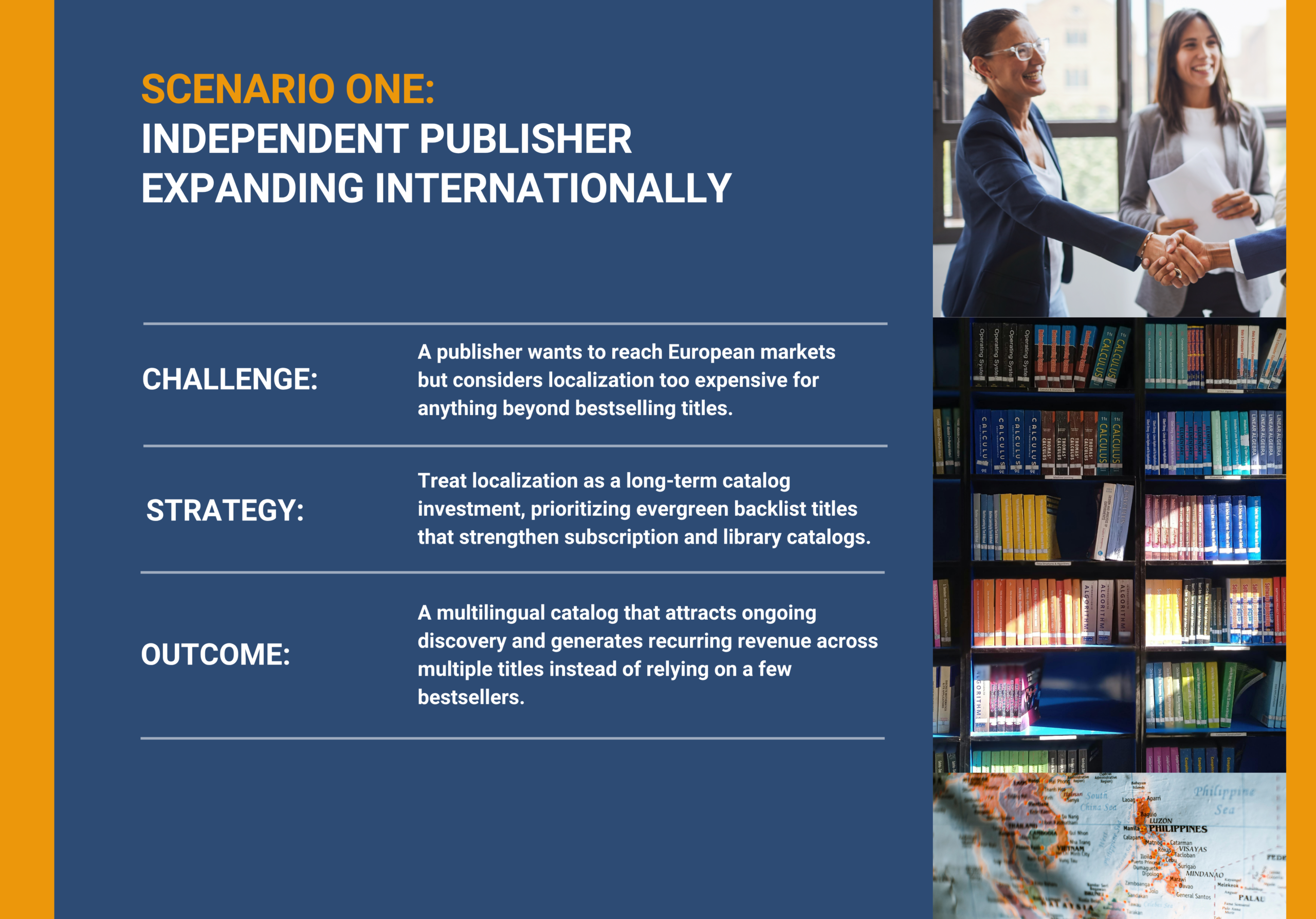
This shift changes production priorities inside L&D departments in the same way it changes them for trade publishers. Onboarding modules, compliance training, and leadership development content produced once with professional narration function as a permanent catalog asset that new employees draw on indefinitely, which means the same economics that favor high-production-value audiobooks over cheaply produced ones apply internally: a flat, poorly narrated training module gets reused just as many times as a well-produced one, but generates measurably worse engagement and retention every single time it’s reused. Making that same training catalog available in multiple languages further extends its long-term value, allowing organizations to deliver consistent, high-quality learning experiences to employees across global teams while maximizing the return on their original production investment.
Real Business Scenarios
Future Trends Beyond 2026
A few dynamics are worth watching closely as this market matures further.
First, the same fandom-driven engagement pattern Deloitte has identified in video streaming, where a smaller group of highly engaged users drives disproportionate subscription value, is likely to emerge in audiobooks as well, rewarding publishers who build genuine series loyalty and consistent narrator relationships over publishers chasing one-off bestsellers.
Second, the gap between AI-assisted production speed and AI-narrated market acceptance shows no sign of closing quickly; publishers should plan multilingual and catalog-expansion strategies around AI as a production accelerant with mandatory human narration and QA, not around a near-term shift to fully automated narration.
Third, as digital audio continues to represent effectively all audiobook revenue, the format’s growth increasingly depends on catalog depth and discoverability rather than any single platform’s marketing spend, reinforcing the importance of long-term investment in high-quality production, strong backlists, and consistently engaging audiobook catalogs.
Key Takeaways
- Audiobook subscription revenue grew 9% in 2025 to $2.43 billion, defying the broader subscription fatigue affecting video streaming.
- The format’s growth is structurally different from most subscription categories because the catalog itself is continuously expanding rather than fixed.
- Subscription platforms reward publishers that invest in deep, well-produced catalogs rather than relying on individual blockbuster titles, making long-term catalog development a key competitive advantage.
- AI’s real economic contribution is expanding which backlist titles clear the threshold for cost-effective, human-reviewed production, not replacing narrators, whom listener data still strongly favors.
- Corporate learning teams are independently adopting the same catalog-thinking logic that governs trade publishing subscription economics.
Ready to build an audiobook catalogue that thrives in the subscription economy?
Success in today’s audiobook market isn’t just about producing more titles—it’s about building a catalogue that keeps listeners engaged over time. From professional audiobook production and multilingual localisation to AI-assisted production workflows and human quality assurance, Accent Network helps publishers create audio catalogues designed for long-term growth across global markets.