
Audiobook Market Trends 2026: What Publishers Need to Know
🔊 Prefer listening? Hit play and enjoy the audio version 🔊
The audiobook is no longer a niche format for long commutes and visually impaired readers. It has become one of the most important growth engines in publishing, attracting new audiences, reshaping discovery channels, and changing how publishers think about production and distribution.
The shift is visible across the industry. Audiobook revenue continues to grow, digital formats now account for virtually the entire market, and audio has outperformed every other major publishing format over the past five years. What was once viewed as a supplementary format is increasingly becoming a core part of publishing strategy.
What makes 2026 a pivotal year is not the growth itself. It is the convergence of three forces: a new generation of listeners with different expectations, a platform landscape transformed by Spotify’s expansion, and AI narration technology that has evolved from experiment to practical production tool.
Together, these changes are redefining how audiobooks are discovered, produced, and consumed. Publishers who understand the implications of this shift will be better positioned to grow their catalogues, reach new audiences, and compete in an increasingly audio-first market.
Audiobook Listener Demographics in 2026: The Audience Has Changed
The core audiobook listener is no longer just an adult commuter. The audience has broadened, and the APA’s own data shows where the growth is coming from.
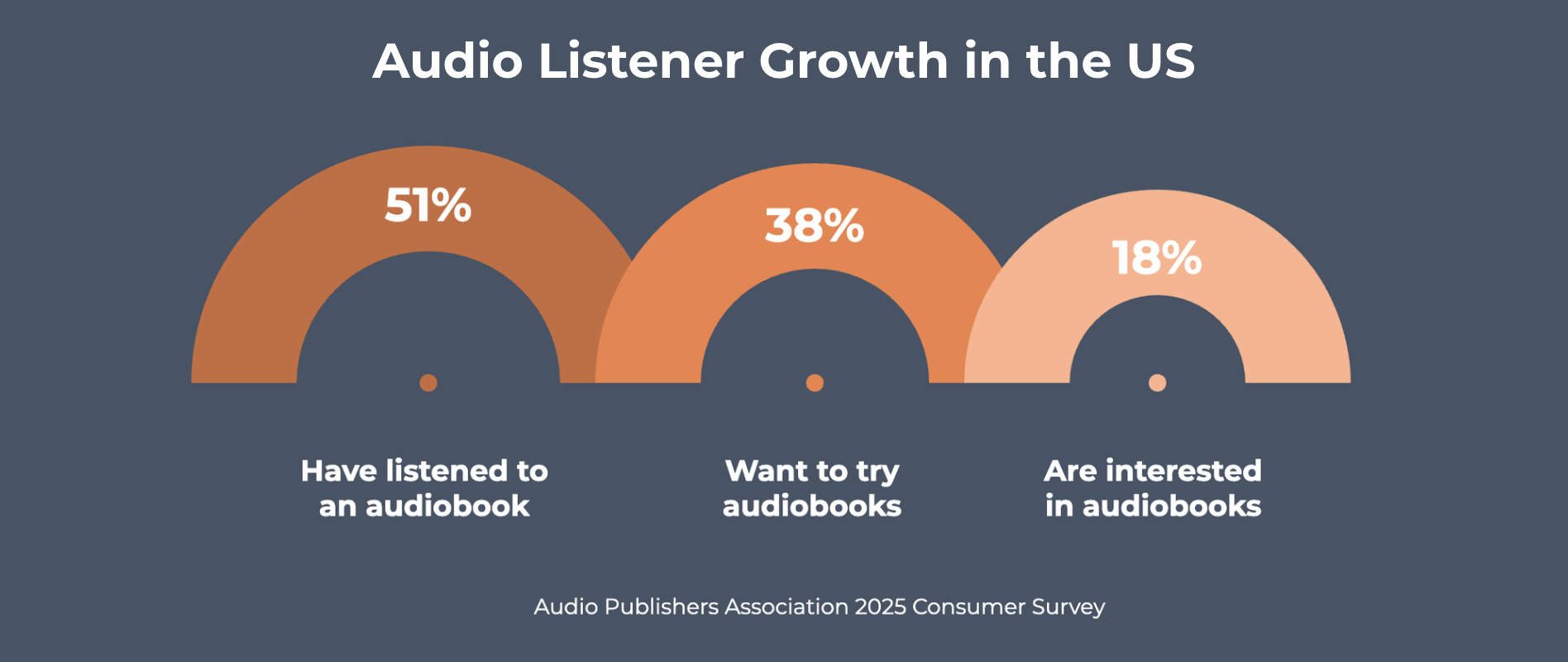
The APA’s 2025 Consumer Survey, conducted by Edison Research, found that 51% of Americans aged 18 and older — around 134 million people — have listened to an audiobook. Interest among non-listeners is also rising: 38% say they want to try audiobooks, up from 32% the year before. The number of those “very interested” nearly doubled from 10% to 18%.
Spotify’s data adds the generational picture. The majority of Spotify’s global audiobook audience is aged 18–34. In English-language markets, more than half of eligible Premium users have played an audiobook. These are not dedicated audiobook fans. They are music and podcast listeners who found audiobooks through a subscription they were already paying for.
What younger listeners expect
This shift changes what content needs to do. Unlike older generations who may see audiobooks as a substitute for reading, younger listeners treat them as a different experience entirely — one that sits alongside podcasts, music, and social media. They are not replacing print. They are adding audio to a diet that never had much print to begin with.
As a result, a title that works in print may not perform well in audio without deliberate adaptation. Fast-paced fiction, strong dialogue, and clear narrative voice translate well. Dense, interior-focused literary prose often does not. Completion data is now the clearest signal of what this audience actually wants — and publishers who track it are making better commissioning decisions.
Where genre growth is happening
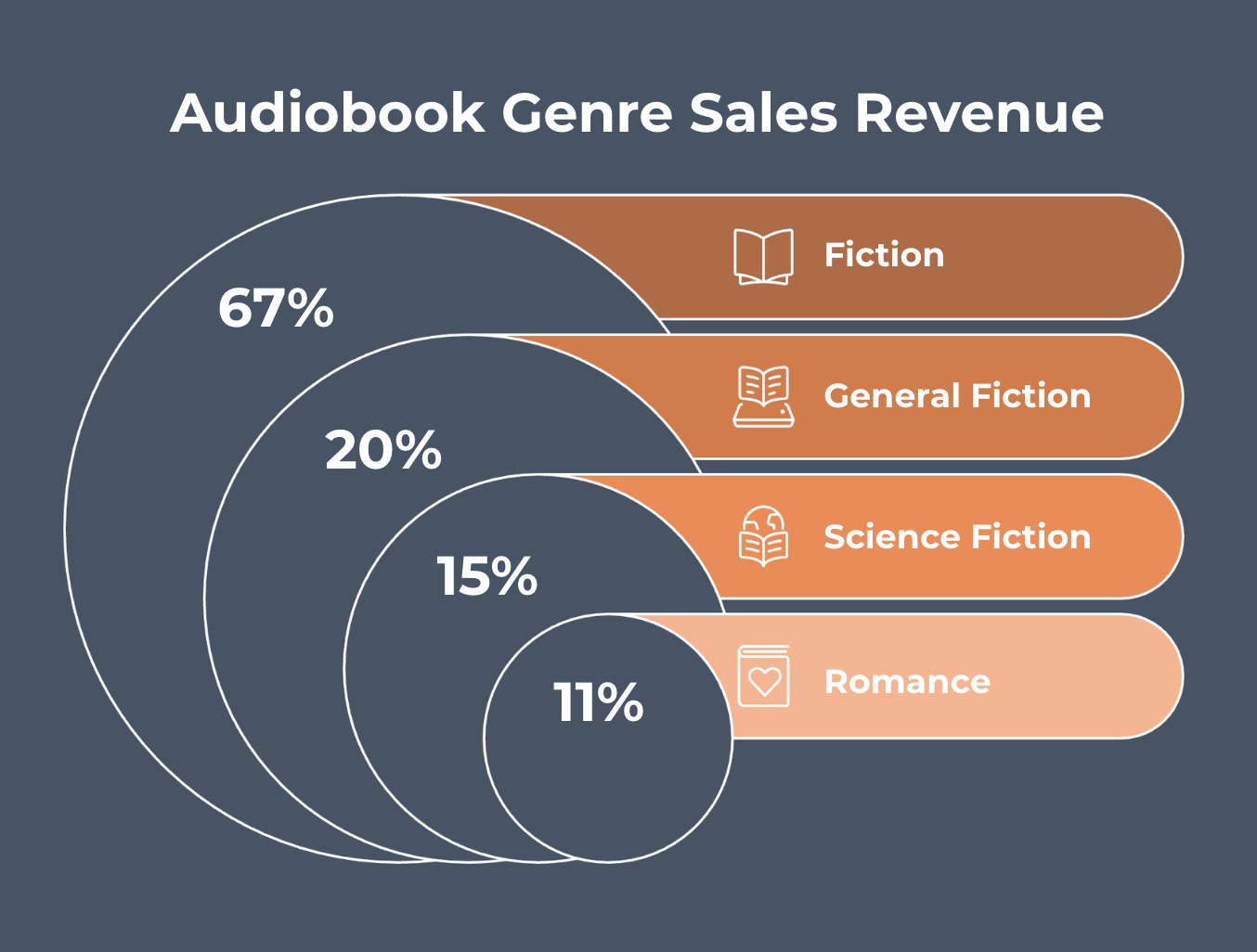
The APA’s genre data makes priorities clear. Fiction accounts for 67% of audiobook sales revenue and has been the top category for four consecutive years. The top genres are General Fiction at 20%, Science Fiction/Fantasy at 15%, and Romance, General Non-Fiction, and Mysteries/Thrillers/Suspense each at 11%.
The fastest-growing genres are:
- Romance (+30%)
- Children’s and YA (+26%)
- Science Fiction/Fantasy (+21%)
For publishers still treating children’s and YA audio as secondary to print, this growth highlights a broader market imbalance. Audience adoption is accelerating, while production investment has not always kept pace.
This matters because younger listeners often encounter stories through audio before they develop long-term reading habits. In that sense, children’s audio is not simply an extension of the print business; it can function as an entry point into a publisher’s wider catalogue and brand ecosystem.
Audiobook Distribution Trends: The Platform Landscape Has Shifted
Audible is no longer the sole centre of gravity in audiobooks.
Spotify entered audiobooks in late 2023 and expanded rapidly across Europe, reaching 350,000 titles by mid-2025. In February 2026, it launched weekly Audiobook Charts in the US and UK, making audiobook discovery more algorithmic and behaviour-driven than ever before.
Spotify has reported ~35–36% year-over-year growth in audiobook listening hours and starters globally. In new markets such as France and the Benelux, listener numbers grew by around 12% per month shortly after launch.
What publishers are actually seeing
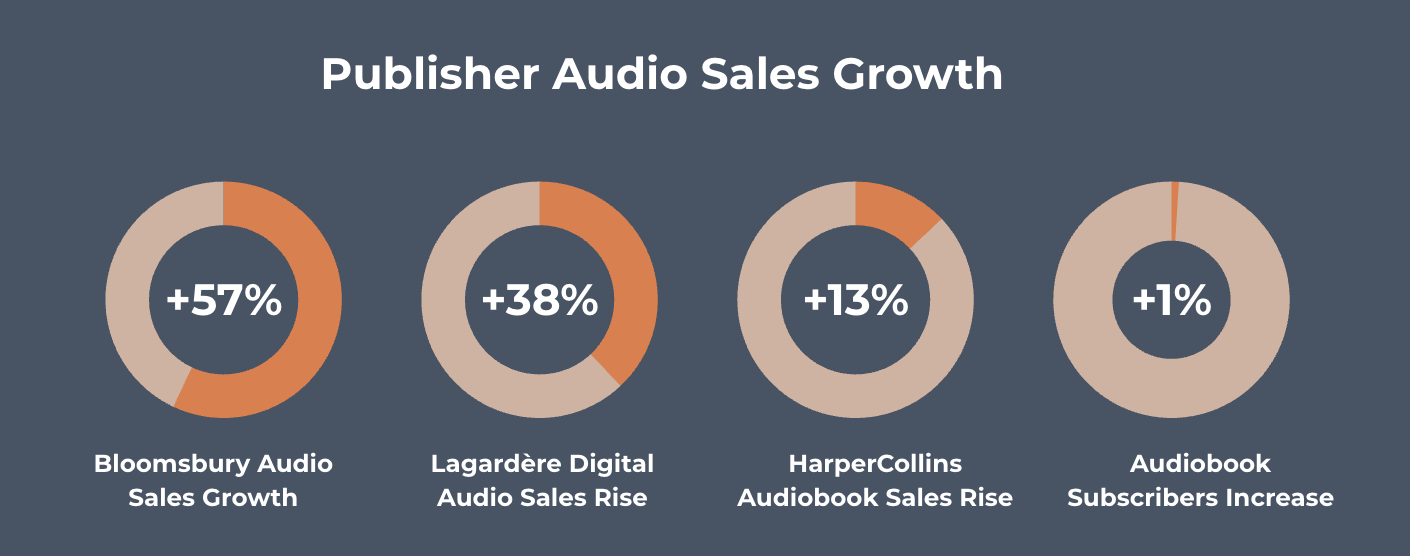
Publishers are already reporting the commercial impact. UK publisher Bloomsbury reported audio sales grew 57% in their 2025 fiscal year, partly driven by their Spotify partnership. French publisher Lagardère noted a 38% rise in digital audio sales in 2024, also driven by Spotify. HarperCollins saw audiobook sales rise 13% in Q4 2024, with parent company News Corp citing Spotify’s market entry as a key reason.
The broader subscription picture reinforces this trend. 63% of those who listened to an audiobook in the past year currently subscribe to at least one service — up from 62% the year before. The per-title buyer is becoming a minority. Publishers who are not present across Spotify, Apple Books, Scribd, and library platforms like Libby are missing the format’s fastest-growing acquisition channels.
The library and YouTube discovery gap
The library channel generates no direct consumer revenue. However, it functions as a primary discovery mechanism, particularly in markets where subscription costs are a barrier. 35% of audiobook listeners have listened via YouTube, up from 27% in 2023. This figure shows how broadly the discovery funnel has expanded — and how important it is for publishers to understand where their audience is actually finding content, not just where they are officially distributing it.
AI Audiobook Narration in 2026: Where It Works and Where It Doesn’t
No topic in audiobook production is generating more debate right now than AI narration. However, the conversation often collapses into a simple binary — human vs. AI — that misrepresents how the technology is actually being used.
The APA’s consumer data is the clearest primary source on listener attitudes. The number of AI-narrated audiobooks has increased, but willingness to try AI narration dropped from 77% in 2023 to 70% in 2025. In other words, more AI content is being made, and more people are consuming it — but the pool of listeners open to trying it is shrinking. Supply is growing faster than trust.
The production economics are real
Production costs that once ran to tens of thousands of dollars per title have fallen sharply. For backlist titles, foreign-language editions, and niche market expansion, the economic case for AI narration is strong. It makes previously unviable catalogue accessible. That is a genuine opportunity, not a compromise.
However, deploying AI narration in categories where listeners expect human performance — literary fiction, celebrity memoir, children’s audio — risks accelerating the trust erosion the APA data already shows. Moreover, platform policy is still evolving. Google Play Books and Kobo accept AI-narrated audiobooks without restrictions. Spotify and Findaway require a written disclosure. Publishers who are not tracking these policies by platform risk distribution problems after production is complete.
The right question to ask
The useful question is not “AI or human?” It is: which titles, in which categories, for which markets? A debut literary novel needs a human narrator. The 12th title in a business series, or a foreign-language edition of a proven backlist title, can justify AI production on commercial grounds without meaningful risk. Publishers who make this distinction deliberately — rather than defaulting out of cost pressure or principle — are the ones gaining ground.
The International Opportunity: Non-English Markets Are Where Next Growth Is
One of the most underinvested areas in audiobook publishing strategy in 2026 is international expansion. Notably, the Spotify data makes the opportunity concrete and specific.
In France and the Netherlands, just one year after Spotify’s launch, listening hours are up 10% month-over-month. In Germany, just six months in, listeners are up almost 10% month-over-month. These are new audiences encountering the format for the first time, through a platform they were already using. The growth trajectory is steeper than anything seen in mature English-language markets at a comparable stage.
Europe’s audiobook market more than doubled between 2020 and 2025. The barrier to capturing further growth is not audience appetite. It is production. A title in English, with a professional narrator and five-platform distribution, still requires a fully separate production process for every language it enters. For most publishers, that means international audio stays an aspiration.
How AI changes the international calculation
AI narration shifts this calculus. A backlist title in German, Dutch, or Polish that would never have justified full studio production can now be tested in market cheaply before any significant investment is made. As a result, the publishers who will lead in international audio are not necessarily the ones with the biggest budgets. They are the ones who use AI production as a market entry tool — and invest in human narration once a title and market have demonstrated real demand.
Discoverability and Metadata: The Infrastructure Layer Publishers Are Underinvesting In
Behind every successful audiobook distribution strategy in 2026 is an infrastructure layer that many publishers still treat as an afterthought: metadata. On subscription platforms where algorithms determine what listeners discover next, metadata is no longer administrative housekeeping — it is a commercial asset.
Spotify’s introduction of weekly Audiobook Charts in the US and UK in February 2026, ranking titles by listener engagement, has made algorithmic visibility more transparent and more consequential than ever before. A title that is miscategorised, under-keyworded, or carrying outdated copy can now be visibly disadvantaged. The gap between publishers who actively manage metadata and those who set it once at upload and never revisit it is widening rapidly.
The impact is particularly visible in the performance of backlist titles. Seven of the top ten audiobooks on Spotify UK in 2024 were backlist titles, five of them more than five years old. This challenges the assumption that subscription platforms primarily reward new releases. Instead, titles with strong metadata and high listener engagement continue to surface in recommendations long after publication, generating revenue from catalogue assets that might otherwise remain hidden.
At the same time, completion rates are becoming an increasingly important discoverability signal. Platforms are prioritising recommendations for audiobooks that listeners finish, creating a direct link between production quality and commercial visibility. A well-produced audiobook performs better with audiences and is more likely to be promoted by recommendation algorithms. In this environment, investments in narration quality and metadata optimisation are no longer separate considerations — both play a critical role in helping audiobooks remain discoverable in an increasingly competitive marketplace.
What This Means for Audiobook Publishers in 2026
The audiobook publishing industry is not navigating a trend. It is navigating a permanent shift in how books are consumed — and the evidence comes from primary sources, not projections.
Digital audio revenue has grown 78.1% in five years, according to the AAP. More than half of Americans have now listened to an audiobook, and interest among non-listeners is rising sharply. Meanwhile, Spotify’s platform data shows younger audiences discovering the format at scale for the first time, in new markets, driven by a subscription model that removes the per-title purchase barrier.
The publishers who will gain ground are not necessarily the largest ones. They are the ones who treat audio as a distinct commercial medium — with its own audience, discovery mechanics, and production logic. That means deciding deliberately where human narration earns its cost and where AI unlocks dormant catalogue. It means being present across the full distribution landscape. It means treating metadata and completion rates as commercial metrics, not admin details. And it means recognising that the fastest-growing part of this audience — younger, subscription-native, international — plays by different rules.
The format has arrived. The question is whether publishers are arriving with it.
Looking to take your audiobook content into new markets and languages?
Expanding an audiobook catalogue internationally — whether through localisation, translation, or multilingual production — requires more than finding a voice in another language. It requires communication that feels native to the audience receiving it. That is exactly what Accent Network helps publishers and content companies do: make sure their content lands the way it was intended, wherever it is heard.