
Male vs. Female Voice Over: What Sells Better?
🔊 Prefer listening? Hit play and enjoy the audio version 🔊
Most voice-casting briefs still come down to one word: “male” or “female.” That’s a simple question, but it’s the wrong first question. The two things that actually predict how listeners respond to a voice are whether it fits the role it is playing and how it is pitched and paced. Gender, on its own, explains surprisingly little.
That’s not just a hunch. It’s the clearest pattern in recent research and it also matches what many experienced creative directors observe from years of casting sessions: the voice that works is rarely chosen because of gender alone. It works because it feels right for the role and the audience.
The voice has to fit the role – not just a gender
A 2025 study in Scientific Reports looked at voice assistants in cars. It tested whether people trusted the assistant more when its voice gender matched what people expect from that kind of role. The answer was yes – but only when the pairing felt expected. When it didn’t, trust didn’t just stay flat. It dropped.
That’s worth sitting with for a second, because it changes what the casting question should actually be. It’s not “do people prefer a male or female voice.” It’s “does this voice match what the listener already expects to hear in this exact spot.” A voice can be warm, well-produced, and perfectly cast in the abstract, and still underperform simply because it doesn’t fit the slot the listener has already mentally prepared for.
Think about how this plays out in practice. A safety announcement on a train platform, a customer-support bot, a luxury car’s onboard assistant, and a children’s toy commercial all carry different built-in expectations about what the voice “should” sound like – shaped by years of exposure to similar ads and interfaces, not by any single conscious decision the listener makes. Match that expectation and the voice barely registers as a choice at all; it just feels right. Break it, and the listener’s brain has to do a little extra work to figure out why something feels slightly off, and that extra work is exactly what shows up as lower trust in the research.
This is also why “test both and see which wins” so often gives a confusing answer. The winning gender in one ad tells you almost nothing about the next one, because the next ad is a different role with a different set of expectations attached to it. A/B testing gender in isolation, without asking what role the voice is meant to fill, is a bit like testing two font sizes without deciding what the headline is supposed to say first. The real question to ask before casting isn’t about gender at all – it’s “what is this voice supposed to be, here, for this audience, in this exact spot?” Once you can answer that, the gender question usually answers itself.
Pitch does more work than gender
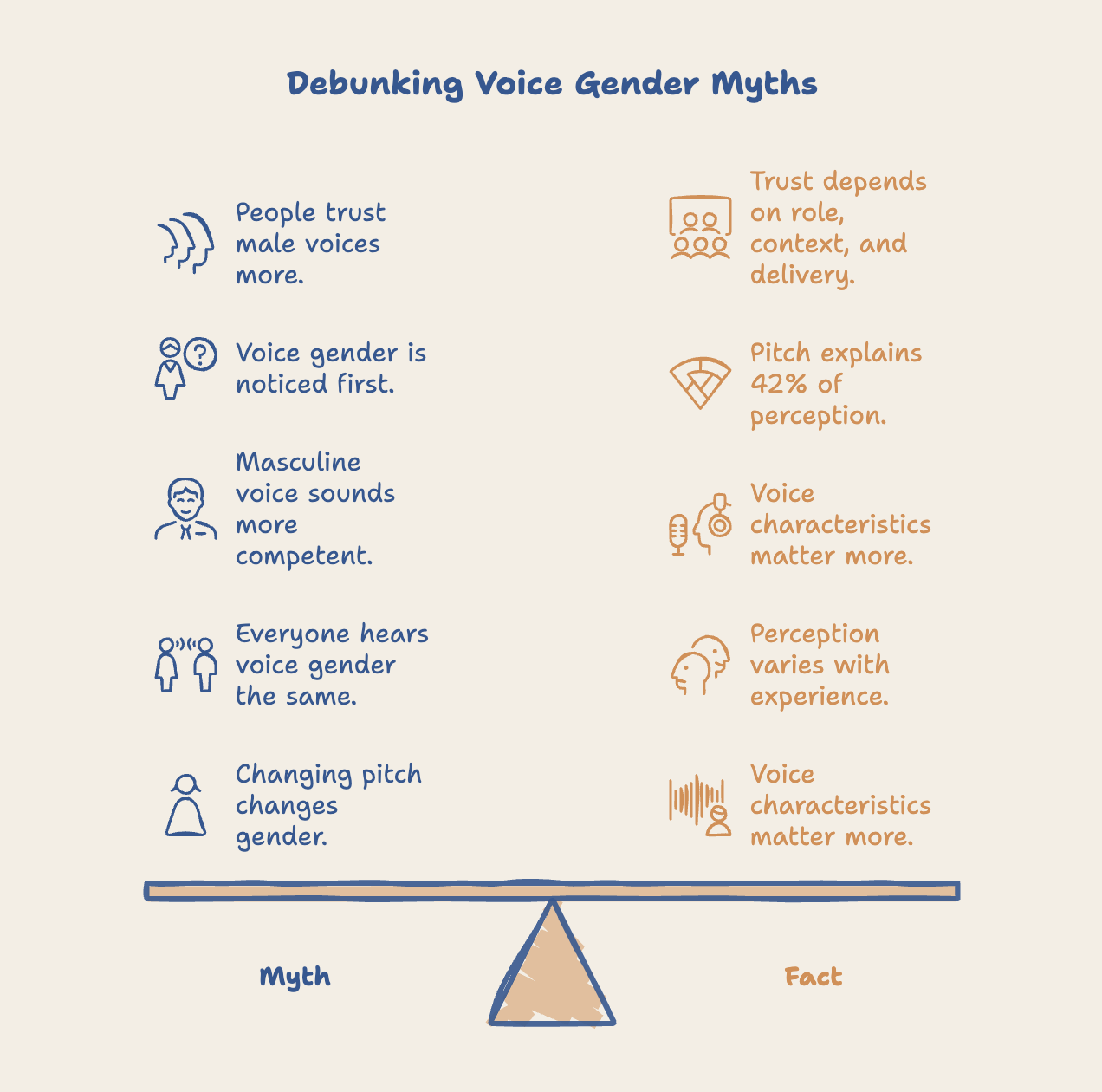
If gender alone isn’t the deciding factor, what is? A 2024 study on radio ads, led by researcher Emma Rodero, tested how pitch affected listeners.
Low, calmer voices scored highest on trust, likability, and memory of the advertisement — and this held true regardless of whether the voice was male or female.
That makes sense once you think about it. A lower pitch is often associated with calmness, confidence, and control. Listeners pick up on these qualities quickly, often without conscious awareness. It’s the same instinct that makes a doctor’s calm, unhurried voice feel more reassuring than a rushed one, even when the words being said are identical.
So a brief that says “low, unhurried, warm” can be more useful than one that simply says “female” or “male.” Two voices of the same gender can create completely different impressions depending on pitch and pacing. A fast, high, clipped delivery and a slow, relaxed one from the same actor can produce very different perceptions of the same brand. Pitch and delivery can be directed and adjusted to create the desired emotional response.
But the way people respond to voices is not only a matter of sound characteristics. It is also connected to how the human brain interprets voices, emotions, and social signals.
The Psychology Behind Voice Preferences
A voice is often the first human element a listener connects with when interacting with a brand. Before people analyse the actual words, they quickly form impressions based on tone, pace, pitch, and delivery. Within seconds, a voice can influence whether a company feels trustworthy, professional, friendly, or emotionally engaging.
For brands, voice is not simply a technical element of communication. It becomes part of the overall identity of a product, service, or experience. A warm conversational voice can make a digital service feel more personal, while a calm and confident delivery can strengthen perceptions of reliability in areas such as finance, healthcare, and education.
People naturally connect vocal characteristics with emotions and personality traits. A relaxed pace can suggest confidence, an energetic delivery can communicate enthusiasm, and a softer tone can create a feeling of support and approachability. These impressions often happen quickly and influence how audiences respond to a message.
However, the meaning of a voice always depends on context. The same voice can create different reactions in different situations. A deep, serious voice may work well for a documentary or business presentation because it suggests expertise and reliability, while a children’s audiobook may require more warmth, playfulness, and emotional expression.
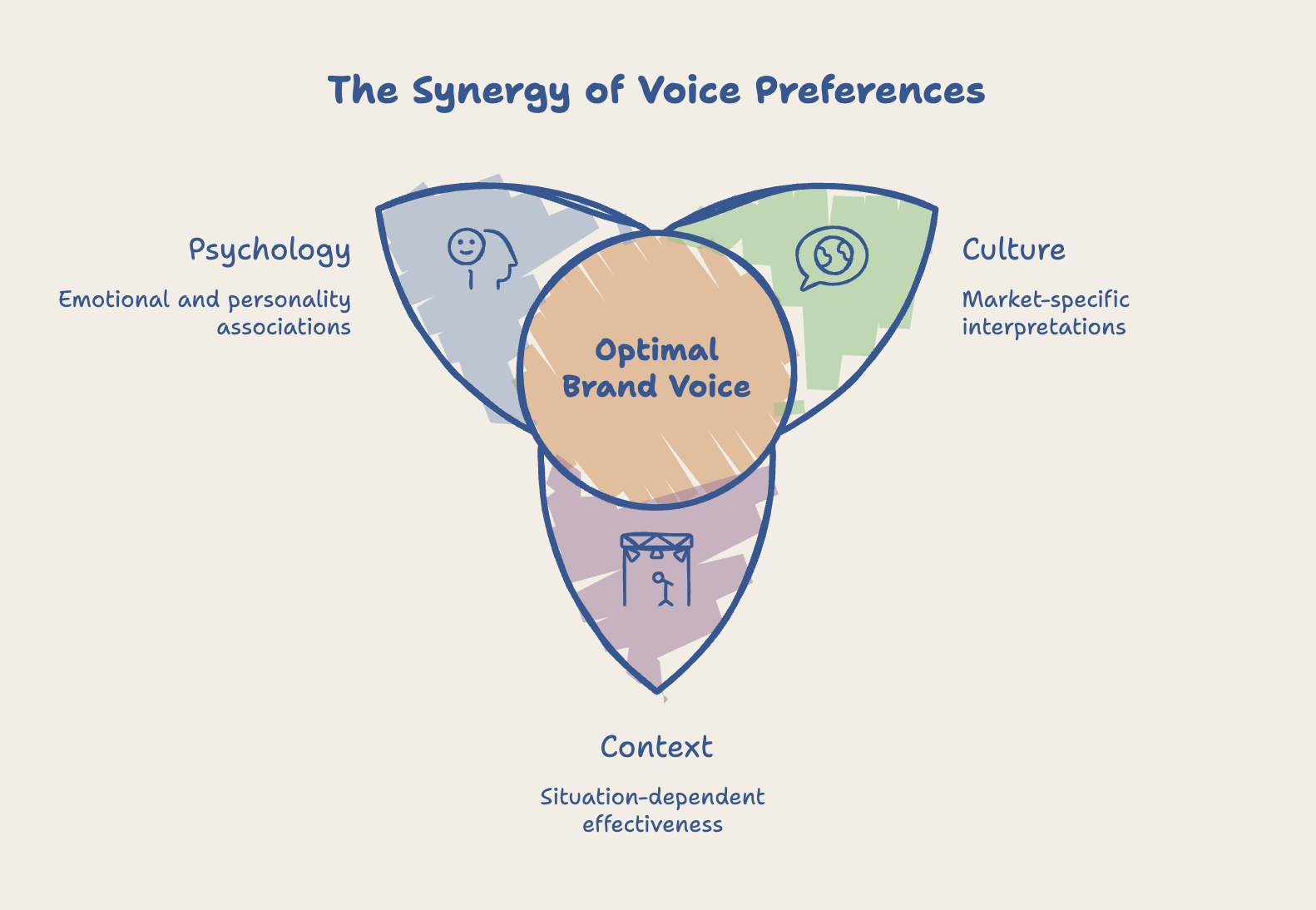
There is no universally “best” voice. The most effective voice is the one that creates the right emotional response for a specific audience and purpose. Whether a message needs to build trust, inspire action, or provide reassurance, the voice should support the feeling the brand wants to create.
Culture also influences how audiences interpret voices. Different markets may associate vocal characteristics with different qualities. For companies producing multilingual content, successful localization requires adapting not only words but also tone, emotion, and communication style.
Ultimately, voice preferences are shaped by psychology, culture, and context. Gender can influence expectations, but it is only one part of a much larger picture. The strongest communication happens when a voice creates a meaningful connection between the message, the brand, and the audience.
So what should a casting brief actually say?
Skip the gender question until last. Start with what the voice needs to achieve. Is it guiding someone, reassuring them, selling to them, or warning them? The purpose of the voice should come before any description of gender.
Then consider the expectations connected to the role. A voice assistant, a financial warning, and a children’s product advertisement may each require a different emotional approach. The best brief describes the feeling and response the voice should create, not just the characteristics of the speaker.
Only after that does it make sense to consider gender. Even then, pitch, pace, tone, and delivery usually provide more useful direction than gender alone. A description such as “low-to-mid pitch, calm, and unhurried” gives a voice actor and director something specific to work with, while “female” or “male” by itself can describe many completely different voices.
Final take
The most effective voice choices are not based on gender alone. A successful voice is one that fits the role, connects with the audience, and delivers the intended emotion. Pitch, pace, tone, and performance often have a greater impact on how a voice is perceived than gender by itself.
A strong voice can still lose its impact if the production quality does not support it. Recording quality, direction, and audio production all play an essential role in shaping the final listener experience. Even the right voice needs the right environment, guidance, and technical treatment to communicate effectively.
At Accent Network, we believe that successful voice projects come from understanding the purpose behind every recording. The best results happen when casting, performance, and production work together to create a voice that feels natural, authentic, and appropriate for its audience. Rather than following fixed rules, each project requires a thoughtful approach based on the message, the market, and the people listening.