
Can AI Replace Human Translators?

Entering international markets requires fast scaling: content must be translated, localized, and distributed across multiple languages. AI promises instant translation, automated subtitles, and AI-generated voiceovers, raising the question: Can AI replace human translators?
Short answer: no. AI is transforming workflows and increasing efficiency, yet human expertise remains essential for strategic language adaptation, brand tone, and cultural nuance. Understanding where AI adds value – and where it does not – is critical for companies expanding globally.
🌍 The Growing Demand for Multilingual Content
Multilingual communication is no longer optional. According to CSA Research, 76% of consumers prefer products in their native language, and 40% will not purchase from websites that aren’t localized. Companies must produce websites, localized product interfaces, subtitled and dubbed videos, marketing campaigns, and customer support resources.
AI can handle high-volume content efficiently. Neural machine translation and AI voicecover tools reduce time and cost, particularly for technical documentation, training materials, and early-stage market testing. But speed alone does not guarantee effectiveness – cultural and strategic context remain essential.
prefer products in their native language
will not purchase from foreign websites
🔎 Translation Is Not the Same as Localization
Al excels at linguistic conversion, yet translation is only one layer of communication. True localization adapts content to cultural expectations, tone, user behavior, regulatory requirements, and interface conventions.
For example, a marketing slogan that feels confident in English may appear aggressive or inappropriate in other markets. Subtle elements like humor, color symbolism, or formality can dramatically affect perception.
Human linguists interpret intent, audience psychology, and brand strategy – capabilities that Al cannot replicate.
⚙️ Where Al Adds Real Value
Al is essential for scaling high-volume content, such as technical documentation, knowledge bases, or internal communications.
In video production, automated transcription, subtitling, and Al voicecover reduce turnaround times and costs. Companies launching content across multiple regions benefit from Al’s operational efficiency.
Al also supports early-stage market entry, providing rapid translations to test new regions before investing in deeper localization.
In these scenarios, Al acts as an accelerator, but acceleration without direction can create misalignment.

🎯 Where Human Expertise Remains Critical
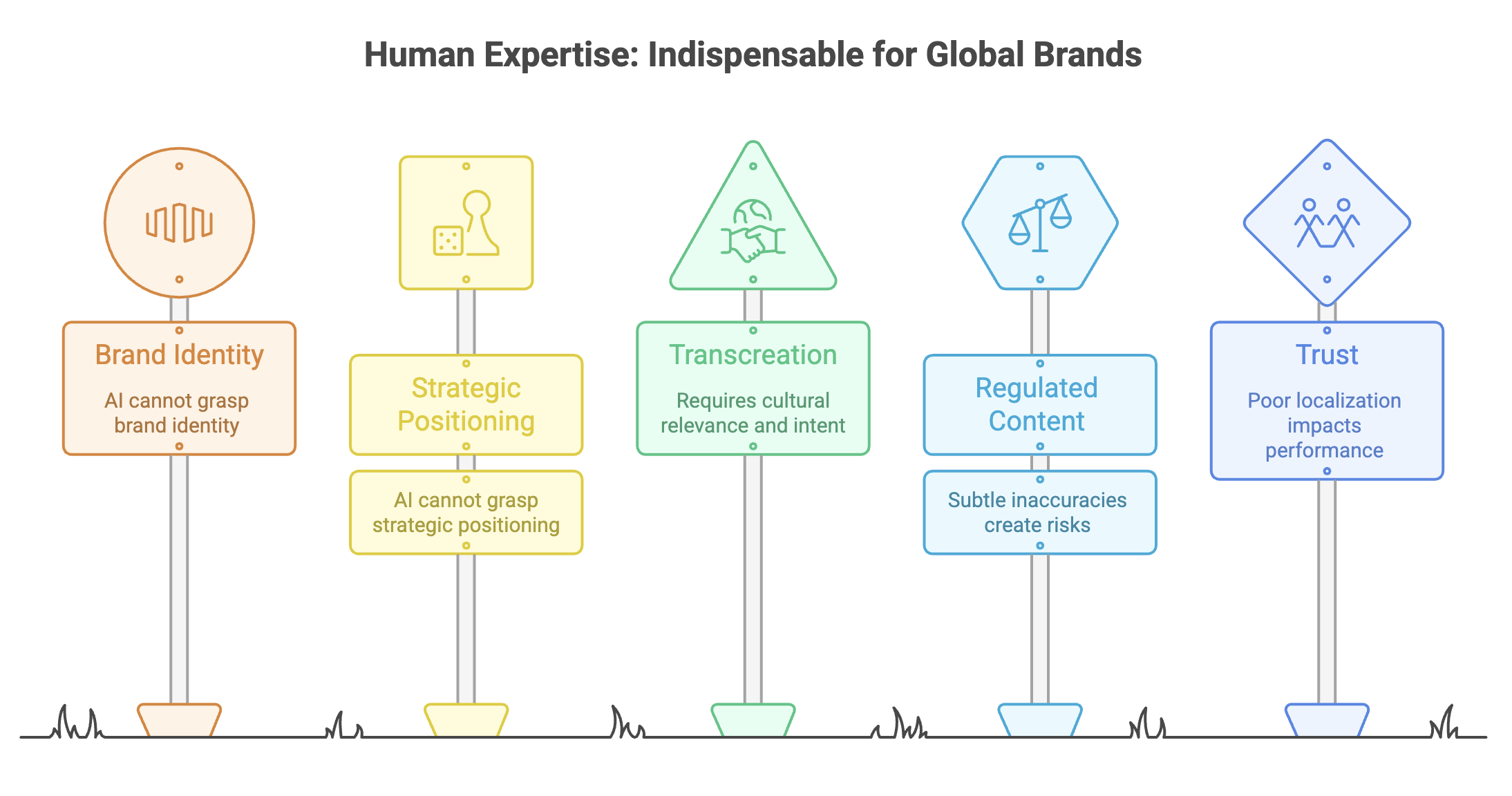
AI can replicate linguistic patterns, but it cannot fully understand brand identity or strategic positioning.
Global brands invest in tone of voice, messaging frameworks, and emotional storytelling. Maintaining these elements across languages requires more than automated fluency.
Creative campaigns demand transcreation – adapting concepts for cultural relevance while preserving strategic intent. Legal, financial, and regulated content requires precise terminology and compliance accuracy.
Trust is also a key factor. Poorly localized content signals a lack of commitment to the audience, which can directly impact performance in new markets. Localization is not merely technical – it is reputational.
⚙️ The Hybrid Model: Combining AI and Human Expertise
The most effective localization strategies combine AI efficiency with human insight. AI assists with draft translation, terminology management, and high-volume content, while humans refine tone, ensure cultural alignment, and maintain brand integrity.
This hybrid approach allows companies to scale globally without sacrificing authenticity, ensuring content resonates with local audiences while supporting business objectives.
Conclusion: Human + AI = Growth in Global Market
AI alone cannot fully capture cultural nuance, brand tone, or strategic intent. The most successful global companies use AI as an augmentation of human expertise, ensuring every piece of content resonates, builds trust, and supports business objectives.
At Accent Network, we combine advanced AI tools with expert human insight.
Such hybrid approach allows companies to:
• Scale multilingual content efficiently
• Preserve brand voice and consistency
• Build trust and loyalty through culturally intelligent localization
🔑 The Bottom Line: AI will not replace human translators – but together, they unlock global growth potential.

Podcast Generation Contextual Translations Video Dubbing
Delivering outstanding outcomes.