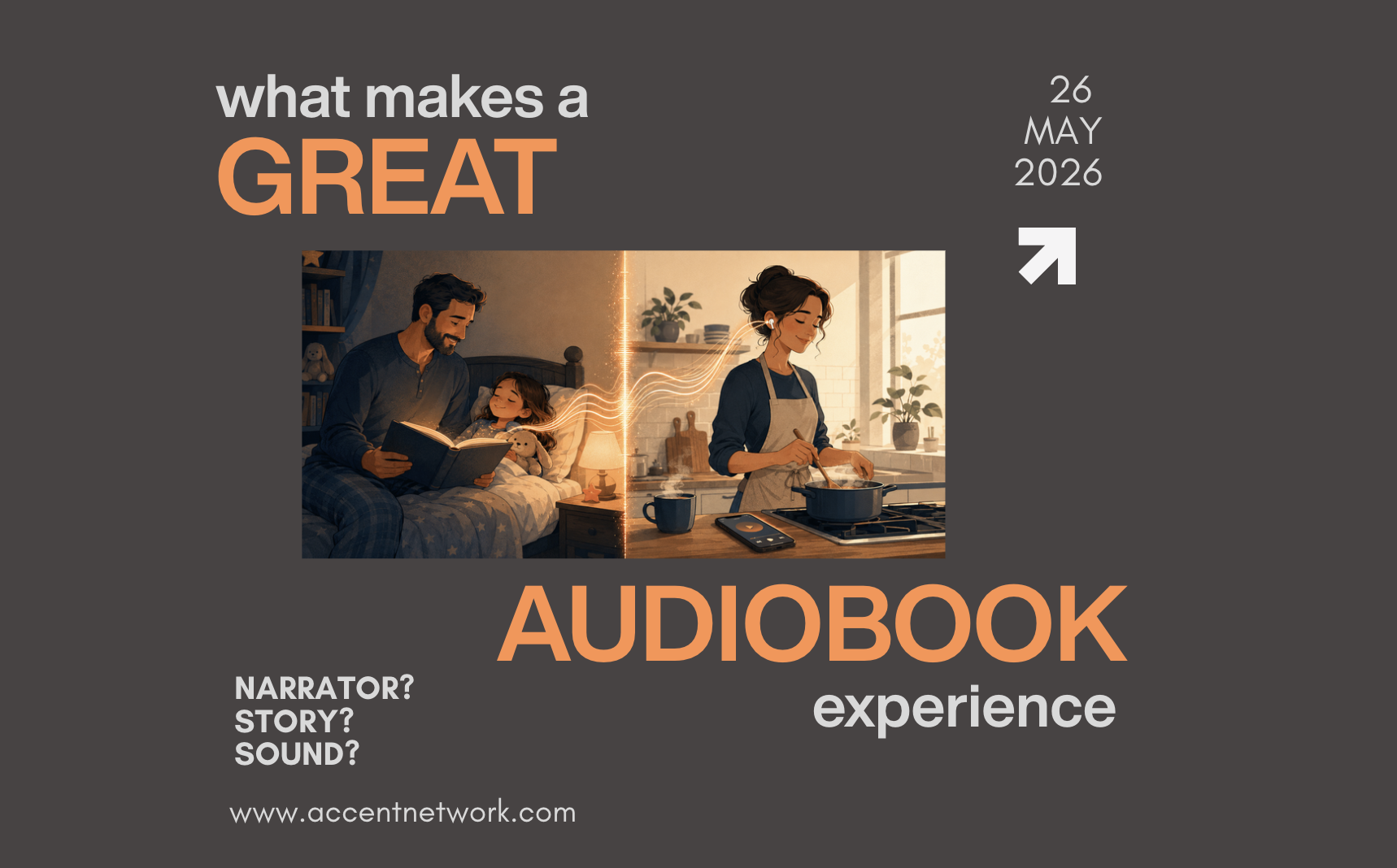

What Makes a Great Audiobook Experience?
🔊 Prefer listening? Hit play and enjoy the audio version 🔊
Audiobooks are no longer a niche format. They are the fastest-growing segment in publishing — and the gap between a title that listeners finish and one they abandon in chapter two almost always comes down to the same set of factors.
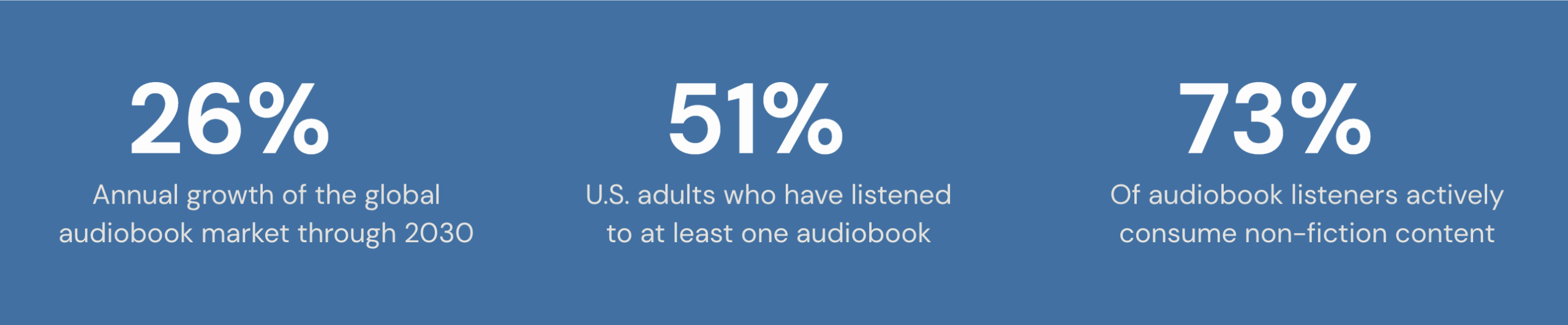
The numbers make it clear why this matters. The global audiobook market was valued at over $8 billion in 2024 and is on track to grow at around 26% annually through 2030. More than half of U.S. adults have listened to at least one audiobook. Publishers who used to treat audio as a nice-to-have are now treating it as a core part of their catalog strategy.
But growth numbers don’t tell you what actually separates a title people finish from one they abandon in chapter two. After years of working in audiobook narration and production across non-fiction, educational, and faith-based content, here’s what we’ve found consistently makes the difference.
The narrator is the book
When someone reads a print book, the voice in their head is their own. When they listen to an audiobook, the voice belongs to the narrator. That’s a big shift — and it means the narrator carries a lot of weight.
A narrator who sounds bored, or like they’re just reading words off a page, will hurt even a great book. Listeners pick up on it quickly, usually within the first few minutes. You can hear when someone is engaged with the material and when they’re just getting through it.
“Great narration isn’t just technically proficient — it’s emotionally intelligent. It understands tone, timing, and when to let the words breathe.”
Good narrators slow down before something important happens. They give dialogue real weight. They keep the storytelling voice distinct from character voices without going full theatre-kid about it. That comes from preparation — actually reading the whole manuscript, understanding where the story goes, knowing which moments need room and which need to move.
For publishers, this means narrator matching matters as much as narrator quality. A voice that works perfectly for a business memoir might feel completely wrong for a devotional. Genre, tone, and audience all matter. Getting this right upfront costs far less than re-recording chapters because it wasn’t working.
Audio production quality: the baseline listeners expect
Listeners have gotten better at noticing bad audio — even if they can’t name exactly what’s wrong. They just feel it as fatigue. Volume that changes between chapters, background hum, room echo, or too much mouth noise in the microphone — none of these are dramatic problems on their own, but they pull people out of the listening experience in small, cumulative ways.
The pandemic years flooded the market with home studio recordings, and while some held up fine, many didn’t. That wave actually raised the bar for what “professional” means, because listeners now have a clearer reference point for what quality audiobook production sounds like.
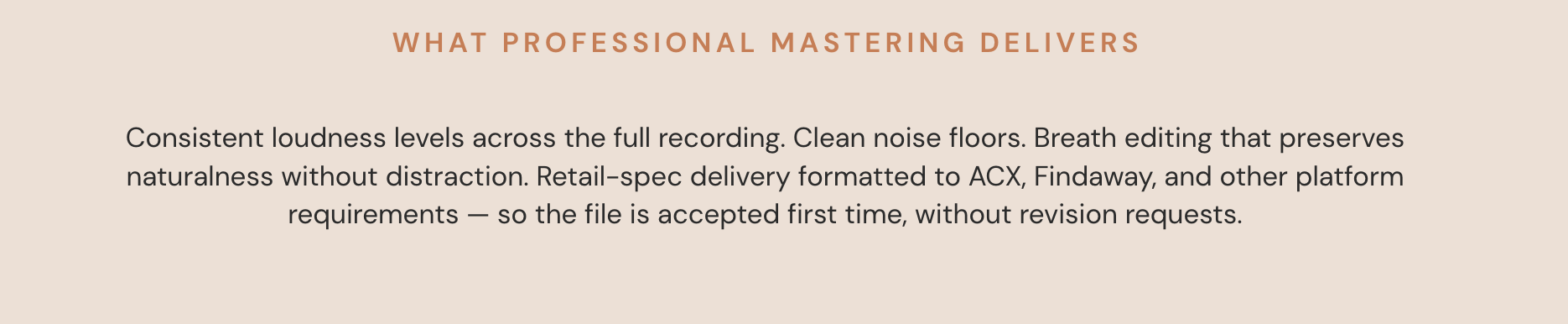
These are not luxury considerations. They are the baseline for a title that will compete on Audible, Spotify, or any major platform. Poor production does not just affect reviews — it affects completion rates, and completion rates affect algorithmic visibility.
Structure and pacing: how audiobook production changes the edit
Audio exposes structural problems that print can hide. A long chapter with dense paragraphs might read fine on a page, but listening to it without visual cues — no page breaks, no white space — can feel exhausting. On the other end, a book with very short chapters can feel choppy in audio if there’s no real throughline pulling the listener forward.
Good production teams catch these things before recording starts. Sometimes that means adjusting chapter breaks. Sometimes it means adding a short transitional sentence. Sometimes it just means choosing a pacing approach that matches the content — because non-fiction, memoir, devotional, and educational material all have different rhythms that a narrator needs to work with, not against.
Multilingual audiobook production: the opportunity most publishers are missing
One of the bigger shifts in audiobook narration and production over the last few years is how much non-English markets have grown. North America still leads in revenue, but Asia-Pacific is the fastest-growing region, and Latin America, the Middle East, and parts of Africa are expanding quickly — driven largely by smartphone growth and the fact that audio works well even in markets where reading habits differ.
For publishers with international rights, this is real money that most aren’t capturing yet. A title in English and Spanish doesn’t just reach more people — it reaches a fundamentally different audience with different listening habits. Faith-based content in particular tends to travel well across languages. The same themes resonate, and international Christian and educational audiences are actively looking for content in their native language.
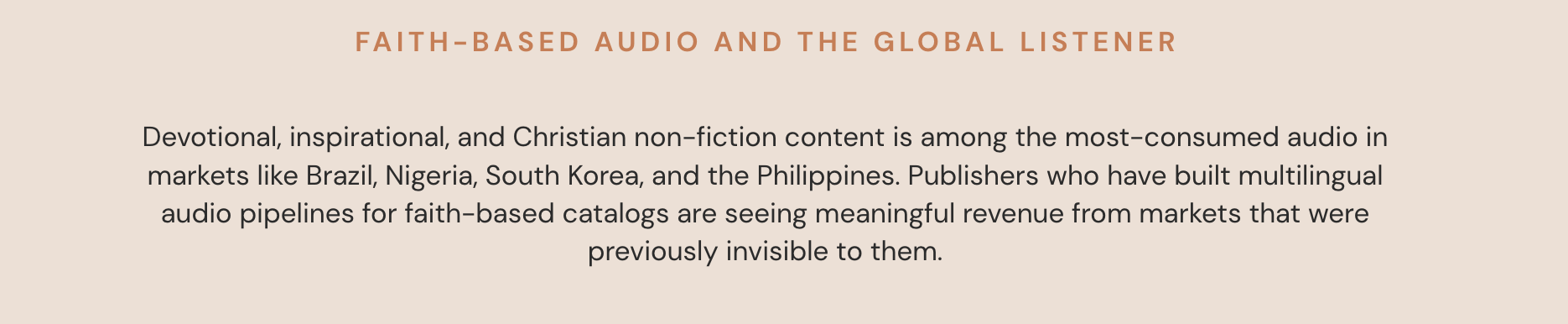
Multilingual audiobook production isn’t just translation. It means finding the right narrator in the target language, making sure the phrasing sounds natural and not like a translated document, and applying the same quality standards to the Spanish or Portuguese version that you’d apply to the English original.
AI vs. human narration in audiobook production: when to use which
AI narration has improved a lot. It’s not the robotic voice from ten years ago. For certain types of content — high-volume backlist conversion, reference material, educational titles where consistency matters more than emotional range — AI-assisted production is a practical option that makes the economics work for titles that might otherwise never get made.
But the distinction isn’t “AI good, human bad” or the other way around. It’s a question of what the content actually needs. A personal memoir, a devotional, a novel with ten different characters — those benefit from human narration in ways AI genuinely can’t replicate yet. The instinctive sense of timing, of when a sentence needs space around it, of how a character sounds when they’re lying — that’s still a human skill.
A business reference guide, a catalog of educational titles for a new language market, or a ten-year-old non-fiction book that’s never been in audio? AI narration can handle those well, at a cost and speed that makes the project viable. The smart approach is knowing which tool fits which project — and having the workflow to use both.
Building an audiobook production pipeline that actually scales
Beyond the individual title, there’s a question most growing publishers eventually run into: how do you build audiobook production into your workflow in a way that doesn’t fall apart under volume?
The typical answer — handling audio case by case, managing separate studio relationships for each title, or leaving it to authors to sort out — creates inconsistent results. Quality varies. Timelines slip. Some titles end up with great audio, others with marginal audio, and some with no audio at all despite demand being there.
Publishers who’ve solved this have built a consistent production process — either in-house or through a dedicated audiobook production partner — with clear quality standards, predictable timelines, and delivery formats that work across platforms. The result is that audio becomes a standard part of every release, not something that gets figured out after the fact.
“A great audiobook is the result of a hundred small decisions made correctly. The voice. The pacing. The edit. The master. Each one either adds to the experience or quietly subtracts from it.”
The market isn’t slowing down. Listeners are more active, platforms are more competitive, and the window to build a real audio catalog strategy is now — not after the competition has already done it. The question isn’t whether audiobook narration and production matters. It’s whether your current setup is ready to handle what comes next.